Ontario litigation · Practitioner guide
AI Witness Preparation for Ontario Litigators: 2026 Guide
A verification-first method for organizing witness materials, comparing accounts, preparing question outlines, and preserving lawyer judgment at every step.

On this page
AI can help Ontario litigators prepare for witness meetings, examinations, and trial by organizing statements, transcripts, affidavits, correspondence, exhibits, and other record materials into a source-linked preparation file. It can compare accounts, surface passages that need follow-up, and produce a first-pass question outline. It cannot assess credibility, decide what evidence a witness should give, resolve a disputed fact, or replace counsel's ethical and strategic judgment. The dependable workflow keeps each proposition tied to the record, separates what the witness actually said from inference, shows competing material, and requires lawyer verification before any output reaches a witness or informs advocacy.
Key facts and limits at a glance
| Task | Useful AI role | Required lawyer control |
|---|---|---|
| Summarize prior accounts | Extract and group passages from statements, affidavits, transcripts, and correspondence. | Check the original passage, context, speaker, date, and locator. |
| Compare versions | Place accounts side by side and flag apparent differences. | Decide whether a difference is material, explainable, or even a true inconsistency. |
| Find supporting documents | Associate testimony topics with documents in the controlled file set. | Confirm authenticity, completeness, admissibility questions, and the proper use of each document. |
| Draft questions | Create a first-pass outline tied to approved topics and sources. | Choose purpose, sequence, form, tone, and whether a question should be asked at all. |
| Prepare a witness | Organize the material counsel has decided to discuss. | Counsel conducts the meeting and avoids turning preparation into a script for evidence. |
| Assess credibility | AI may surface record conflicts for review. | AI should not label a witness truthful, deceptive, reliable, or unreliable. |
Define the preparation purpose before processing the file
“Prepare this witness” is too vague for a reliable AI instruction. The work changes depending on whether counsel is preparing a client for discovery, reviewing a potential fact witness, developing a cross-examination outline, testing an affidavit against productions, or planning a trial meeting. Start with a short preparation charter approved by the responsible lawyer. It should identify the witness, the proceeding and stage, the live topics, the materials in scope, the date cut-off, the required source convention, and the intended use of the output.
State the limits as clearly as the task. If the purpose is to compare a witness's examination answers with contemporaneous correspondence, say that the system must not decide credibility, infer motive, invent missing facts, or recommend what the witness should say. If the purpose is a cross-examination outline, identify the approved topics and require a source reference beside every proposed confrontation point. The narrower instruction creates a file that is easier to verify and less likely to mix extraction, legal analysis, and strategy into one polished answer.
A practical preparation charter
- Witness and role: identify the person without assuming the legal significance of their evidence.
- Purpose: state the meeting, examination, motion, discovery, or trial-preparation task the file will support.
- Topics: use lawyer-approved factual or evidentiary questions rather than an open-ended request for “all issues.”
- Population: list the authoritative source set, versions, date range, exclusions, and known processing failures.
- Locators: require the file name plus the best available page, paragraph, line, exhibit, or timestamp.
- Escalation: specify what must remain unresolved for counsel and what uncertainty labels the output must use.
Control the witness record before asking AI to compare it
A witness file can contain several kinds of material that should not be silently blended: sworn evidence, unsworn statements, transcripts, interview notes, pleadings, productions, expert material, client instructions, lawyer work product, and legal research. Build an inventory before analysis. Keep source types distinct and preserve their dates and versions. A statement attributed to a witness should not become interchangeable with an allegation in a pleading or a summary in counsel's notes.
Record technical limits as part of the file. Missing attachments, illegible scans, image-only pages, poor OCR, incomplete transcripts, duplicate productions, and documents outside the date range can all distort the result. Reconcile the processed collection against the inventory. If a source failed extraction, mark it unavailable rather than allowing its silence to be treated as evidence that no contrary passage exists.
Confidentiality review comes before upload. The appropriate approach depends on the matter, client obligations, firm policy, contractual terms, the tool's safeguards, retention and use of inputs, access controls, and the minimum information needed. The LSO AI guide tells licensees to understand the relevant risks and terms, consider redaction, and avoid entering protected information where adequate safeguards are absent. One workflow or vendor setting is not a universal answer for every witness file.
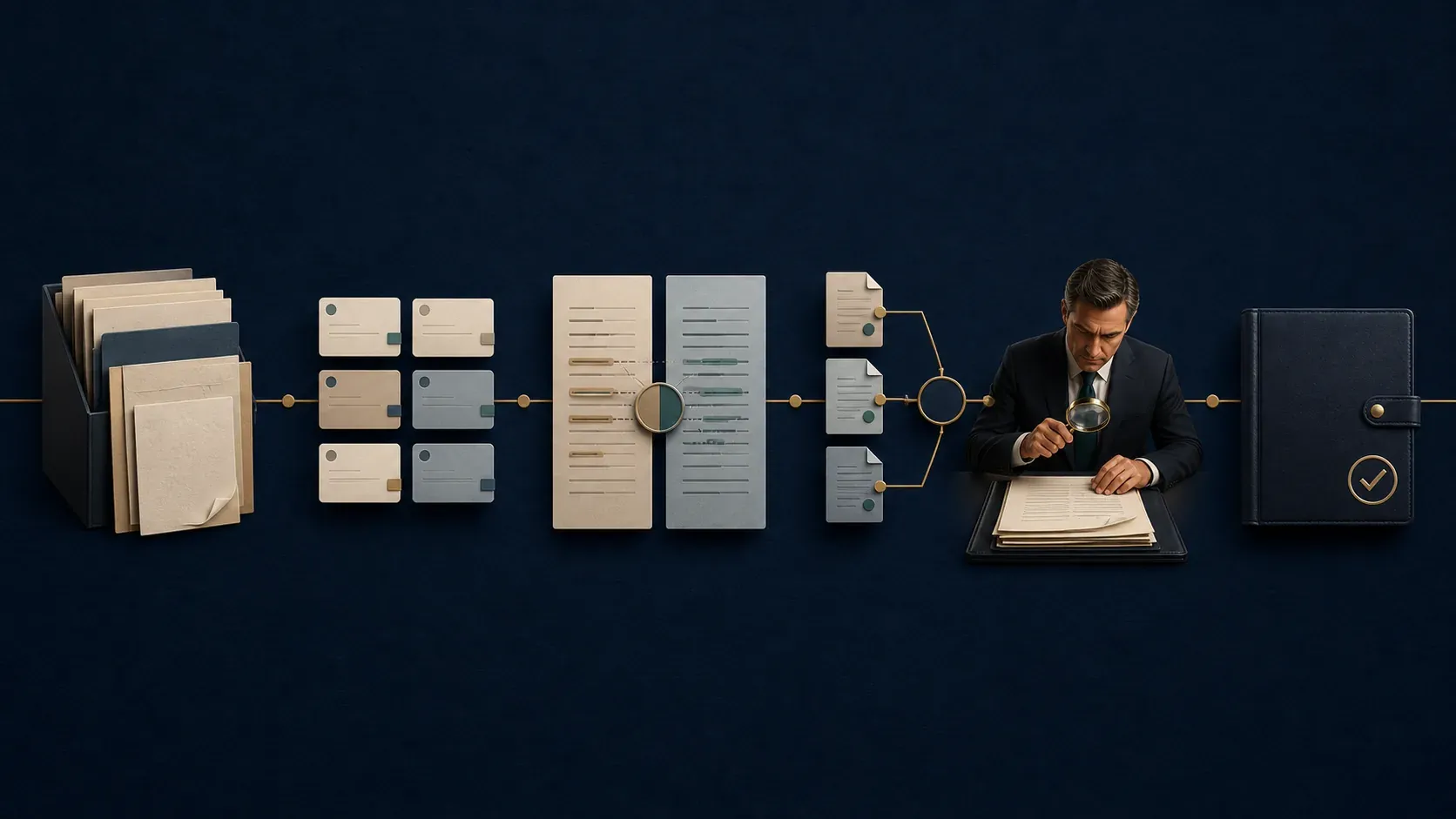
A six-step AI witness-preparation workflow
- Freeze the source set and instructions. Record the included files, versions, cut-off date, witness, purpose, approved topics, locator convention, and reviewer. Preserve this run note so a later reader can understand what the system did and did not review.
- Extract accounts before comparing them. Build a neutral chronology of what the witness said, when, in which source, and at what locator. Keep direct quotations visibly distinct from paraphrases. Do not ask for credibility or strategic conclusions in this pass.
- Compare accounts and related records. Place relevant passages side by side. Surface apparent differences, corroborating material, documents mentioned but not found, ambiguous references, and topics that appear only in later versions. Label each item as a candidate for review, not a proven contradiction.
- Build source-linked preparation topics. For each topic, state the proposition, the supporting passage, any competing passage, related documents, uncertainty, and the question counsel may need to resolve. Do not collapse competing versions into a synthesized “fact” unless counsel has approved that characterization.
- Draft separate meeting and examination outlines. A preparation-meeting agenda and an examination or cross-examination outline serve different purposes. Keep them separate. Require a purpose and source beside each proposed question, then let counsel decide sequence, form, tone, and use.
- Verify, approve, and preserve decisions. Open the original sources, correct errors, record accepted and rejected items, and mark unresolved questions. Save the approved version and the reviewer's decisions without treating the AI draft as the authoritative file.
Build a preparation file that exposes uncertainty
The most useful preparation file is not the one with the smoothest narrative. It is the one a lawyer can challenge quickly. Use fields that keep source, interpretation, and decision apart. A short point with two precise locators is often more useful than a confident paragraph that hides where its conclusion came from.
| Field | What it should contain | Quality-control question |
|---|---|---|
| Topic | A neutral, lawyer-approved factual subject. | Is this scoped to the preparation purpose? |
| Witness account | A quotation or careful paraphrase with date and source locator. | Does the source actually say this in context? |
| Related record | Documents or testimony that support, qualify, or differ from the account. | Were contrary and surrounding passages included? |
| Status | Unverified, verified, disputed, incomplete, or outside scope. | Could a reviewer mistake a candidate point for a finding? |
| Preparation question | A neutral topic or question for counsel to consider. | Does it invite the witness's own recollection rather than supply an answer? |
| Examination purpose | The record-based reason counsel may use a proposed question. | Is the purpose documented without predicting an answer? |
| Reviewer decision | Accepted, revised, rejected, deferred, with a short reason where useful. | Is lawyer judgment visible? |
Worked example: a disputed project instruction
Assume a witness said in an examination transcript that a change was first requested during a Tuesday call. The controlled file also contains a Monday email discussing a possible change and a Wednesday project note recording that approval was still pending. The AI system should not announce that the witness contradicted the documents or that any source proves authorization. It should build a reviewable comparison.
- Extract the transcript passage. Record the witness's exact answer or a faithful paraphrase, with page and line references.
- Identify related documents. Link the Monday email and Wednesday note with their dates, authors, recipients, and stable file locators.
- Describe the difference neutrally. The Monday email may show discussion before the Tuesday call; it does not necessarily establish when a request was made or approved.
- Expose the open questions. Who participated in the call? What did “possible change” mean? Was there a separate instruction? Is an attachment missing?
- Separate outputs. Put the chronology and source comparison in the preparation file. Put any proposed examination sequence in a separate lawyer-review outline.
- Record counsel's decision. Counsel may accept the point, revise its characterization, seek another source, defer it, or decide not to use it.
Develop question outlines without losing the source trail
Question generation is safer when counsel supplies the topic and intended purpose. Ask the system to propose alternatives, not a finished script. A useful row can include the topic, proposed question, reason for asking, anticipated source reference, competing material, and a caution about assumptions in the wording. Counsel can then remove compound questions, loaded premises, repetition, and points that depend on unresolved authenticity or context.
Keep preparation-meeting questions open enough to test recollection and understanding. A generated outline should not tell a witness what the evidence “must” be. For an examination or cross-examination outline, counsel controls the legal and strategic choices: what proposition matters, whether the foundation exists, how documents may be used, when to stop, and how the sequence fits the rest of the case. AI can organize possible paths; it cannot conduct the advocacy or predict how the witness will answer.
Use the preparation file in the witness meeting
The approved file should support the lawyer's meeting, not run it. Counsel can use the topic map to confirm the witness's own recollection, review the process and setting, locate documents the witness needs to understand, identify uncertainty, and note follow-up work. Keep a visible distinction between the underlying source, counsel's preparation note, and any later account given by the witness.
Do not turn a generated narrative into a model answer. The current LSO advocacy rules govern counsel's conduct as an advocate, including prohibitions connected with false evidence and misleading the tribunal. The practical control is straightforward: use AI to organize what the record contains, let the witness give their own evidence, and have the responsible lawyer decide how preparation proceeds in the circumstances of the actual matter.
Update the file after the meeting carefully. A new recollection or correction should be recorded as such; it should not silently overwrite the earlier statement or be backfilled into the source chronology. Preserve the version trail and identify what still requires a document, another witness, legal research, or strategic review.
Scale the review across a litigation team
Large witness files often require a team, but adding reviewers can create its own source and version problems. Assign roles before the first AI run. One person should control the source inventory and processing log. Reviewers can own defined witnesses, topics, or date ranges. The responsible lawyer should approve the preparation charter, decide disputed characterizations, and sign off on anything that will be used in a witness meeting or examination plan. A clear handoff matters more than the job title attached to each step.
| Role | Primary responsibility | Handoff evidence |
|---|---|---|
| Collection owner | Freeze the file list, versions, date cut-off, exclusions, and failed extractions. | Source inventory and processing log. |
| First-pass reviewer | Check extracted accounts and candidate comparison points against assigned sources. | Verified locators, corrections, and unresolved flags. |
| Topic reviewer | Test supporting, contrary, qualifying, and contextual material for an approved topic. | Source-linked topic row with a proposed disposition. |
| Responsible lawyer | Control legal significance, strategy, witness interaction, and final use. | Approved preparation file and separate meeting or examination outline. |
Use a controlled vocabulary for review status so “checked,” “complete,” and “approved” do not mean different things to different people. For example, source checked can mean that a reviewer opened the cited passage and confirmed the extraction; it should not imply that the point is strategically useful or legally admissible. Counsel approved can mean that the responsible lawyer has decided the point may enter the current preparation plan. Define these states in the run note and prevent automated formatting from upgrading one status into another.
Version the work around decision points. Preserve the source inventory, the first verified comparison, the file approved for the meeting, and any later revision based on new information. Do not allow a regenerated summary to overwrite reviewer notes. If the source set changes, record what was added or removed and identify which approved points need to be rechecked. This makes the next update narrower and helps counsel explain the provenance of the preparation work without presenting the AI output as evidence.
Run a point-by-point verification pass
Verification means opening sources, not checking whether the output sounds plausible. Review every material quotation, paraphrase, date, speaker attribution, page or line locator, document relationship, and statement about what is absent from the collection. Read enough surrounding context to catch qualifications, corrections, objections, adopted evidence, translation issues, and references to exhibits or attachments.
Challenge the comparison itself. Did the system compare statements about the same event? Did it confuse a proposed action with an instruction, a draft with a final document, or a witness's personal knowledge with information received from someone else? Did OCR change a number or name? Did the prompt ask only for inconsistencies and thereby suppress corroborating or explanatory material? A verification pass should search for reasons the candidate point may be incomplete.
Record the reviewer's disposition. Use a small controlled set such as accepted, revised, rejected, unresolved, and outside scope. If a point moves into an examination outline, preserve the source and purpose beside it. If it is removed, retaining a short decision note can prevent the same weak point from returning in the next automated run.
The Ontario court-use boundary
A private preparation file and material used in a court proceeding are not the same thing. If AI-assisted work contributes to court materials, counsel must apply the requirements governing that filing and proceeding. The Ontario Superior Court of Justice's current Consolidated Civil Provincial Practice Directionstates that counsel and litigants are responsible for accuracy when preparing materials for use in court proceedings, particularly when using AI, and directs careful, informed, and ongoing oversight. It also requires legal information obtained with AI assistance to be verified against trusted and authoritative sources.
That direction does not make an AI witness-preparation file court evidence or resolve how a witness, transcript, document, or proposed question may be used. Those issues depend on the actual proceeding, governing law and procedure, the record, and counsel's judgment. Before a preparation point migrates into an affidavit, factum, examination plan, demonstrative, or other court-facing work, verify it again for that distinct purpose.
A verified Curia workflow for witness preparation
Curia's public Matters page describes a workspace where documents, research, and drafts carry context together. For witness preparation, that supports a narrow workflow: organize the relevant matter materials, keep research and draft work connected to the same file context, and move verified points into a lawyer-reviewed preparation outline. Curia's public Research page describes cited Canadian case law with direct links to underlying decisions when a separate legal question needs authoritative research.
Those features do not determine credibility, make a legal finding, guarantee completeness, or decide which questions counsel should ask. The lawyer still controls the source population, confidentiality assessment, instructions, verification, meeting, examination strategy, and final work product. Keep the witness's evidence and the lawyer's approved decisions distinguishable from AI-generated organization.
Common errors, limits, and exceptions
- Calling every difference a contradiction. Accounts may address different times, questions, assumptions, or levels of detail.
- Blending source types. Allegations, instructions, lawyer notes, testimony, and documents should not become one undifferentiated narrative.
- Using a one-sided prompt. Asking only for damaging passages can hide corroborating, qualifying, or explanatory material.
- Trusting generated locators. Page and line references can be wrong even when the surrounding summary looks convincing.
- Ignoring collection failures. Missing attachments, bad OCR, and unprocessed files should remain visible limitations.
- Automating credibility labels. A system should not convert record conflicts into findings about truthfulness or reliability.
- Using one outline for every purpose. A witness meeting, discovery, cross-examination, affidavit review, and trial preparation require different controls.
- Letting the output script the witness. Preparation should not replace the witness's own recollection and evidence with a generated narrative.
- Skipping the court-facing recheck. A verified internal note still needs purpose-specific review before it contributes to court materials.
- Overclaiming tool capability. Source links and polished organization do not prove completeness, admissibility, accuracy, or legal significance.
Practical checklist for Ontario litigation teams
- Define the witness, proceeding stage, preparation purpose, approved topics, and prohibited conclusions.
- Inventory the authoritative source set, versions, date cut-off, exclusions, and processing failures.
- Complete the matter-specific confidentiality, access, retention, and vendor review before upload.
- Extract each account with a date, speaker, source type, and stable page, paragraph, line, exhibit, or timestamp.
- Keep quotations, paraphrases, allegations, instructions, research, and inferences visibly separate.
- Compare supporting, contrary, qualifying, and contextual passages—not only apparent inconsistencies.
- Label candidate points and unresolved gaps so they cannot be mistaken for findings.
- Separate the preparation-meeting agenda from any examination or cross-examination outline.
- Give every proposed question a purpose, source, competing material, and reviewer decision.
- Open the original sources and verify every material point, locator, quotation, date, and attribution.
- Preserve the witness's own evidence and record later changes without overwriting earlier versions.
- Recheck any point before it contributes to court-facing work and verify legal information against authoritative sources.
- Save the approved version, reviewer identity, decision trail, and unresolved follow-up items.
Key takeaways
- AI is most useful for witness preparation when it organizes a controlled record and exposes the source trail.
- Extract accounts before comparing them; compare them before drafting questions.
- An apparent inconsistency is a review point, not a credibility finding.
- Preparation-meeting and examination outlines should remain distinct, lawyer-controlled work products.
- Every material proposition, quotation, locator, and attribution needs original-source verification.
- Court-facing use requires a fresh purpose-specific check under current law, rules, and court directions.
Primary and authoritative sources
- Law Society of Ontario, Generative AI: Your Professional Obligations.
- Law Society of Ontario, Rules of Professional Conduct, Chapter 3.
- Law Society of Ontario, Rules of Professional Conduct, Chapter 5.
- Ontario Superior Court of Justice, Consolidated Civil Provincial Practice Direction.